Guides & basics
What is a twistlock? A rotating lock that locks containers together; it is also written Twist Lock. It sits in the corner casting, the particularly robust fitting at each corner of a container. Our manual twistlock for containers is described on the product page; this guide explains how the locking works, what types there are and what connects containers standing side by side.
How does a twistlock work in the corner casting?
At each of its eight corners, a container has a corner casting of this kind, also known as a corner fitting. These corner castings have elongated holes. The twistlock engages in them with its rotating head and so locks the containers together, as the Transport-Informations-Service of the GDV describes.
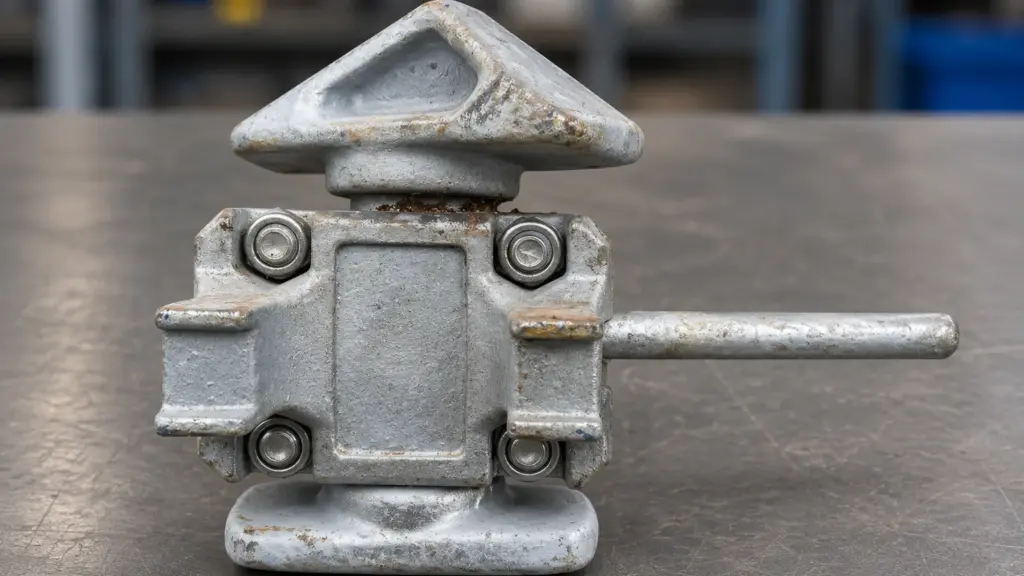
As the encyclopedia of the manufacturer Wärtsilä (in English) states, locking is done by rotating the movable part about a vertical axis; the reverse movement releases the connection again.
As the Containerhandbuch of the GDV states, the corner castings, together with the corner posts and the rest of the frame, absorb the forces that act on the container during stacking, handling and transport via locking units or lashings; cranes also lift the container at these points.
What types of twistlock are there?
Three types can be distinguished by how they are operated, depending on whether they are locked and released by hand or automatically.
| Type | How it is used and operated | Source |
|---|---|---|
| Standard twistlock (manual) | Locked by hand and released by hand. | Encyclopedia of the manufacturer Wärtsilä (in English); designation “Standard-Twistlock” according to the manufacturer Finsterwalder |
| Semi-automatic twistlock | Inserted into the upper corners of the lower container; the container placed on top locks automatically through its weight, and is released by hand. | Manufacturer Finsterwalder; encyclopedia of the manufacturer Wärtsilä (in English) |
| Fully automatic twistlock (also spelled fully-automatic) | Fitted to the lower corners of the container at the quay; locks when the container is set down and unlocks when it is lifted, each time by itself. | Encyclopedia of the manufacturer Wärtsilä (in English) |
According to Finsterwalder, the semi-automatic twistlock is the successor model to the standard twistlock; it is used to secure stacked containers with cast steel corners. Exactly how it is released depends on the model: with Finsterwalder's semi-automatic twistlock, a pull cable is operated for this. According to the product page, our twistlock is a manual twistlock; we state the technical data in the quote.
Stacking containers: where the twistlock sits and what it does not do
Twistlocks are placed between the containers: they sit in the corner castings of one container and engage in the lower corner castings of the next. Which corners they go into first depends on the type.
According to the overview of stacking fittings of the manufacturer Finsterwalder, stacking fittings such as the twistlock and stacking cone connect container to container or container to vehicle and protect them against slipping or lifting off, either temporarily or long-term depending on the model.
On truck chassis, too, containers and swap bodies are locked at the corner castings with twistlocks. On the deck of container ships, twistlocks together with lashing rods, that is, steel rods for fastening containers, and turnbuckles form the lashing system; specialist companies calculate it for each ship.
A twistlock does not replace the planning of the stack. Under the safety regulations, stacked containers must be secured against toppling and shifting as required; according to the Containerhandbuch, the permissible stacking load is to be noted on the CSC plate, the approval plate on the container. How high containers may be stacked at your site, and how they may be secured, is something to clarify with the manufacturer of the parts or a specialist company.
Connecting containers side by side: the bridge fitting
When containers stand side by side, a different part comes into play. According to the product page, a bridge fitting connects two containers standing side by side at the corner castings, horizontally at the top edge, into a single unit.
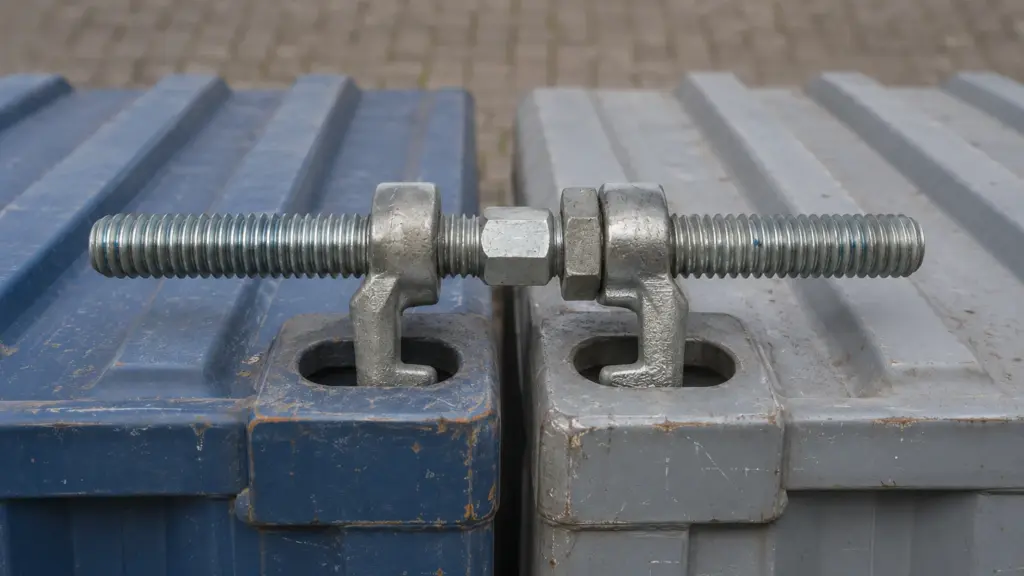
According to the product page, it is used in multi-part storage, office or modular solutions, often together with twistlocks. The manufacturer Finsterwalder also lists the twistlock and stacking cone under “Securing on top of one another” and the bridge fitting under “Securing side by side”.
The twistlock and bridge fitting therefore do not replace one another: the twistlock connects containers standing on top of one another, the bridge fitting those standing side by side. The bridge fitting complements the twistlock when several containers are to form an installation.
Twistlock or container lock?
A twistlock connects containers at the corner castings and does not protect against theft; anyone who wants to secure the contents retrofits a container lock to the door, usually a lock box. The twistlock therefore secures the connection of the containers to one another, the lock secures the door.
What to look out for when choosing
You can clarify whether a twistlock suits your containers and your use with the help of these points:
- Shape of the corner casting: According to the Containerhandbuch, the ISO 1161 standard lists various shapes of corner castings for top and bottom, and mirrored for right and left. The twistlock must match the corner casting it is placed in.
- Corners of the container: According to the manufacturer Finsterwalder, stacking fittings are generally used in the container corners and are therefore recommended for containers with cast steel corners or reinforced corners made of folded steel.
- Type of locking: Whether locking is by hand or automatic depends on the type. Choose the type to match how your containers are stacked and moved.
- Position and secure fit: For securing on vehicles, the Containerhandbuch gives two points: the position “Open” or “Closed” must be recognisable at once, according to the CTU guidelines cited there, and locking units must be firmly tightened.
- Technical data: Ask the manufacturer of the respective part for technical values; for our twistlock we state them in the quote.
- Quantity: According to the product page, the quantity depends on the use. State in your enquiry how many containers are to be connected.
You can read general information on the ISO standards for containers in the guide ISO containers explained simply.
Frequently asked questions about the twistlock
What is a twistlock?
A twistlock is a rotating lock that locks containers together at their corner castings. Its rotating head engages the elongated holes of the corner castings. Turned, it locks; the reverse movement releases it again. It is placed between the containers and connects containers standing on top of one another.
What alternatives are there to the twistlock?
For securing on the vehicle, the CTU guidelines cited in the Containerhandbuch name securing cones and securing rails alongside twistlocks. As a further stacking fitting, the manufacturer Finsterwalder lists the stacking cone alongside the twistlock. Containers standing side by side are connected by the bridge fitting, as a complement to the twistlock, not as a replacement.
What types of twistlock are there?
Three types can be distinguished, depending on how they are locked and released. The standard twistlock is locked and released by hand, the semi-automatic twistlock locks through the weight of the container placed on top, and the fully automatic twistlock locks when set down and unlocks when lifted, each time by itself.
Does a twistlock fit every container?
That depends on the corner casting. Corner castings to ISO and to the older American ASA standard differ in dimensions and shape, according to the Containerhandbuch; most ASA containers have since been brought to ISO dimensions. Whether a particular part fits your containers is something to clarify with the manufacturer or a specialist company.
Enquire about parts and containers
The product pages describe our twistlock and the bridge fitting. Coin Container primarily sells containers. If you need containers for a stack or an installation, you can send an enquiry via Request a quote; the enquiry form also has a field for accessories.