

Coin Container organises transport from the depot to your delivery address - throughout Germany and Europe.
Coin Container organises transport from the depot to your delivery address. This can be conventional truck transport, delivery by crane truck or side loader or, for longer distances, a combined solution by rail or inland waterway vessel.
Distance is not the only important factor. What matters most is how the container is to be offloaded on site and whether the vehicle can safely reach the placement location at all.
If you send us the delivery address, container size and some information about access, we can plan the right transport solution straight away.
What transport options does Coin Container offer?
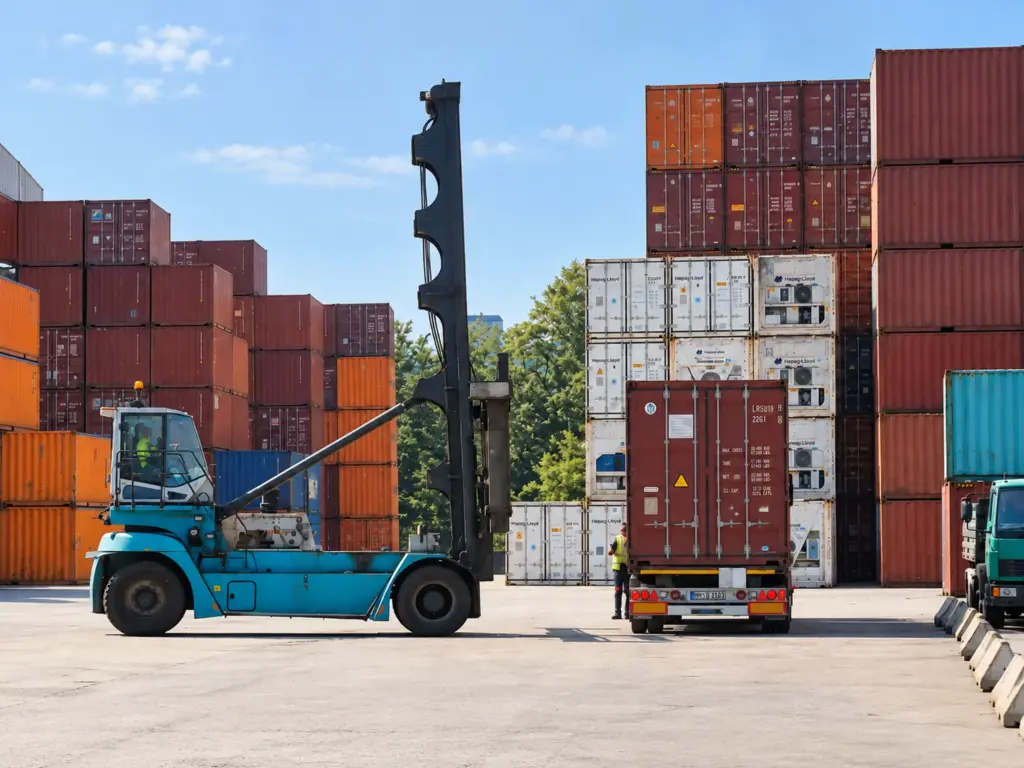
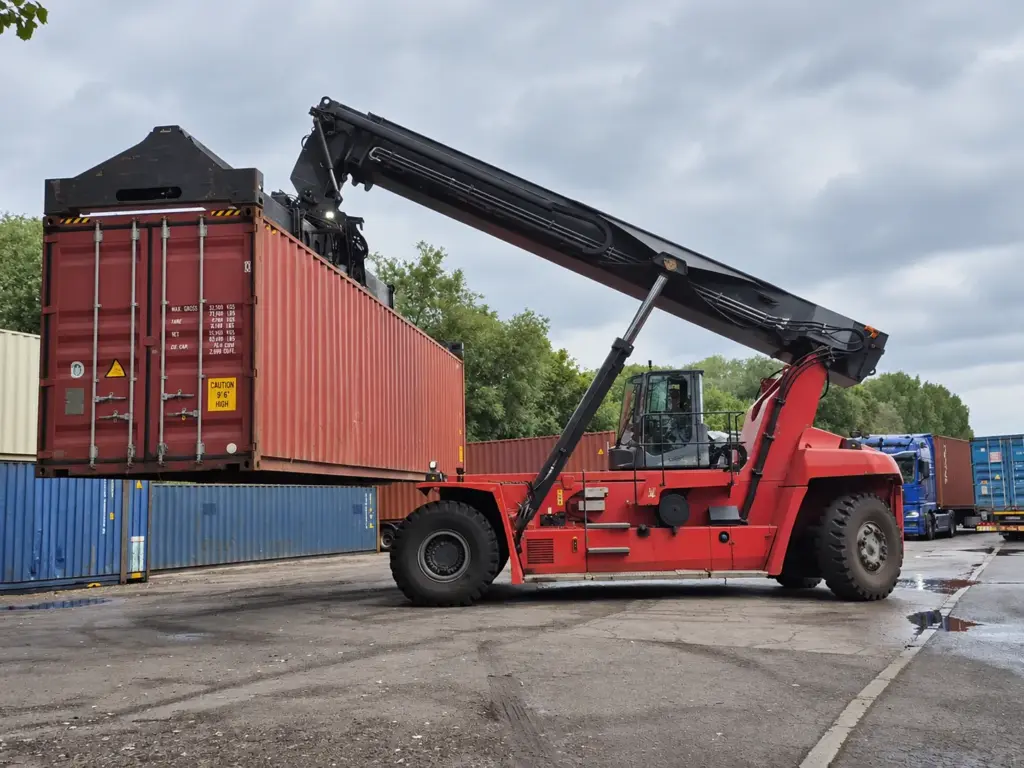
Containers are not always located where they will be needed later. That is why transport planning is an integral part of the purchase for many orders.
We organise transport for standard 20 ft and 40 ft containers as well as for High Cube containers, refrigerated containers (reefers) and various special containers.
Delivery does not automatically start from the nearest known port. What matters is where a suitable container is available and which depot location is logistically well placed for the delivery address.
This helps avoid unnecessarily long transport routes.
1. Delivery by crane truck

If there is no crane of your own at the delivery location, the container can be delivered by crane truck and offloaded directly on site. For this we work, for example, with SST Spedition GmbH as one of our reliable transport partners.
The container is transported on the vehicle and then lifted into the intended position with the loader crane.
What is easily underestimated during planning: it is not only the container that needs space. The truck also needs sufficient room – as do the extended outriggers and the crane's working area.
For a typical delivery, roughly the following requirements should be met:
- at least approx. 7 m working width,
- at least approx. 7,50 m clear working height,
- about 2 m of additional space in front of or behind the container,
- a load-bearing surface for the vehicle and outriggers.
How far from the vehicle the container can be offloaded cannot be stated as a general rule. The crane, the weight of the container and the local situation determine the possible working area.

Where space is tight, photos of the access route and the planned location are usually more helpful than a long description.
2. Delivery by side loader

A side loader works differently from a crane truck.
The container is offloaded to the side of the vehicle. To do this, the truck drives as parallel as possible to the future location. In the direction of travel, unloading usually takes place on the right-hand side.
The following are usually required for delivery:
- approx. 7 m working width,
- at least approx. 5,50 m clear height,
- about 2 m of additional space in front of or behind the container,
- a firm, load-bearing surface.
The side loader is particularly suitable when the container is to be placed directly next to the access route.
On narrow sites, a few centimetres between the vehicle, the fence and the location can be decisive. Even a wide gate is of little help if the truck cannot swing out directly behind it.
3. Transport by truck without unloading

If a suitable crane, reach stacker or other lifting equipment is already available at the delivery location, the container can be delivered on a container chassis.
Coin Container organises the transport to the agreed address. Offloading is carried out by the customer or the equipment available on site.
This form of container delivery is common, for example, on industrial sites, construction sites, depots and larger commercial locations.
4. Container transport by rail

For longer distances, part of the transport route can be by rail.
The container is first taken to a suitable terminal, covers the main leg by rail and is then transported onwards by truck to the delivery location.
Rail transport does not suit every route. What matters most are the regions of departure and destination and a suitable terminal connection.
5. Container transport by inland waterway vessel
An inland waterway vessel can also be part of the logistics chain on longer transport routes.
This is particularly interesting where sea ports or inland ports can be sensibly integrated into the route. The last leg to the delivery location is then usually by truck again.
6. Collecting the container yourself

Not every container has to be delivered by us.
Depending on the order, self-collection from the depot is also possible. For this you need a suitable transport vehicle or container chassis and the prescribed load securing.
The exact depot location and the collection date are agreed as part of the order.
Access, location and ground
The container fits on the area. But can a 40-tonner get there too?
For delivery, this question is often more important than the size of the location alone.
A container truck is long and heavy and needs significantly more room to manoeuvre than the area where the container will ultimately stand.
Access and manoeuvring area
Before delivery, please check in particular:
- width of the access route,
- clearance height,
- tight bends,
- turning and manoeuvring options,
- parked vehicles,
- trees and low-hanging branches,
- roof overhangs,
- walls and fences,
- street lamps,
- overhead cables.
A gate, for example, may be wide enough for the truck – but if a tight bend follows directly behind it, the access route may still be unsuitable.
For properties in residential or commercial areas in particular, it is therefore worth checking the entire route from the roadside to the placement location.
Load-bearing ground

Container vehicles reach a high gross weight together with the load.
With a crane truck or side loader, the extended outriggers also create high point loads.
The ground should therefore be level, sufficiently firm and load-bearing.
A solid yard surface can work without any problems. A waterlogged lawn, loose gravel or a paved area with insufficient load capacity, on the other hand, can cause difficulties.
If you are unsure, please send us photos of the access route and the area.
The right placement location
Where the container is to stand later should, if possible, be clarified before delivery.
The following are helpful:
- photos of the placement location,
- a simple sketch,
- the desired orientation of the container,
- the position of the doors,
- distances to walls or buildings,
- information on other obstacles.
The door side in particular is easily forgotten.
If the container is later placed too close to a wall, a fence or another container, the doors may not be able to open fully.
Even small details can therefore be important for positioning.
Container transport in Germany and Europe
Coin Container organises container transport within Germany and to numerous European destinations.
Not every container has to start from the same depot.
The closer a suitable container is available to the delivery location, the shorter the transport route can be. We therefore also check during planning which depot location is suitable for the respective order.
In addition to locations in Germany, depots in neighbouring European countries can also be used – depending on stock and destination region.
This is particularly interesting for delivery addresses near the border and longer transport distances.
How much does container transport cost?
Distance is important, but it is not the only cost factor.
The calculation takes into account, among other things:
- starting depot,
- delivery address,
- container size,
- number of containers,
- vehicle used,
- unloading on site,
- additional crane or lifting effort,
- special conditions at the delivery address.
A 20 ft container on a standard chassis is therefore calculated differently from a 40 ft High Cube container that is to be delivered by crane truck and positioned on the property.
Waiting times or additional lifts can also affect the price.
You can find specific information and examples on our page about transport costs and delivery times.
We need this information for transport planning


For an initial assessment, a few details are usually enough:
- desired container size,
- number of containers,
- full delivery address,
- desired delivery date or period,
- desired type of unloading.
For delivery by crane truck or side loader, additional photos are particularly helpful.
Ideally, the photos show not only the actual placement area, but also the access route, gate, manoeuvring area and any possible obstacles.
This allows many queries to be clarified before delivery scheduling.
Frequently asked questions about container transport
Can the container be offloaded directly on my property?
Yes. If the access route, placement area and ground are suitable, the container can be offloaded directly on site, for example with a crane truck or side loader.
Do I have to organise a crane myself?
Not necessarily. With delivery by crane truck or side loader, offloading may already be part of the transport.
How much space does a crane truck need?
Allow for a working width of around 7 m. The crane also needs clear height as well as sufficient space for the vehicle, outriggers and crane movement. The specific requirements may vary depending on the vehicle used.
How much space does a side loader need?
A side loader also needs a working width of approximately 7 m. It is particularly important that the vehicle can be positioned parallel to the intended placement area.
Can 40 ft High Cube containers also be transported?
Yes. In addition to 20 ft and 40 ft standard containers, we also organise transport of High Cube containers, refrigerated containers and various special containers.
My access route is narrow. What should I do?
Send us photos and, if possible, the most important dimensions. A picture of the entire access route is often more helpful than just a photo of the placement area.
Can I collect my container myself?
Depending on the depot and order, self-collection is possible. This requires a suitable vehicle including appropriate load securing.
Does Coin Container also deliver abroad?
Yes. In addition to container transport within Germany, we organise deliveries to numerous European destinations.
Request container transport
Would you like to have a container delivered? Send us the container size, delivery address and the preferred offloading method. For narrow access routes or special site conditions, it is best to include a few photos straight away. This allows us to check which type of transport suits your location and plan the delivery accordingly.
If you have questions about container transport or would like personal advice, we are available at any time. Our team will help you choose the right delivery solution and get your container to its destination safely and reliably
Enquire now
Our services
Transport and delivery at a glance