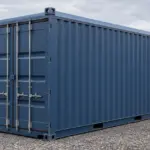
Guides & basics
According to the official announcement, GTA VI is released on 19.11.2026. If you are already negotiating over the living room, there is a way out: a gaming container in the garden, your very own level behind the house. This article is your quest log for size, permit, power, conversion, delivery and rental.
Mission Gaming Container: a room of your own in the garden
The idea is a gaming lair of your own in the garden for you, your family and friends, separate from the house. The console no longer has to leave the TV after co-op night, and the living room stays free. The next release night takes place in the container, not between the dining table and the laundry basket.
Before the first round, it is worth walking around the garden, because a lot depends on the location: access, cable routes and shade.
Character select: which size suits a gaming room in the garden?
When it comes to size, you decide whether your room is designed for solo or co-op mode. The High Cube has around 30 cm more interior height than a standard container with the same floor area. For a room where you spend time, a High Cube is usually the best choice, because more standing height remains after interior insulation.
| Containers | Interior length × width | Interior height |
|---|---|---|
| 10 ft Standard | approx. 2,83 × 2,35 m | approx. 2,39 m |
| 10 ft High Cube | approx. 2,84 × 2,35 m | approx. 2,70 m |
| 20 ft Standard | approx. 5,90 × 2,35 m | approx. 2,39 m |
| 20 ft High Cube | approx. 5,90 × 2,35 m | approx. 2,70 m |
Source: product pages and dimensions table on coin-container.de, as of 18.11.2026.
The values apply before fit-out. Interior insulation reduces the usable interior space, so allow a little breathing room for a sofa and desk. For the footprint in the garden, the external dimensions count: the 20 ft High Cube measures approx. 6,06 × 2,44 × 2,90 m on the outside, the 10 ft High Cube approx. 2,99 × 2,44 × 2,90 m (length × width × height).
The 10 ft High Cube is intended for sites with little space. For multiplayer evenings with friends, a 20 ft container is the better fit. For more on this size, see the page where you can buy a 20 ft container.
Checkpoint building authority: does a container need a permit?
Here we hit pause for a moment, because this checkpoint is no joke. Whether a container needs a permit depends on its use, its size, how long it stays in place and the federal state; the binding answer comes from the competent building authority. According to our guide, a permanently installed container that is used as a living space needs a permit practically everywhere. Clarify this with the building authority before you buy, for example with an informal enquiry. For an overview, see our guide to building permits for shipping containers; it offers orientation, not legal advice.
Power-up: electricity, internet and climate
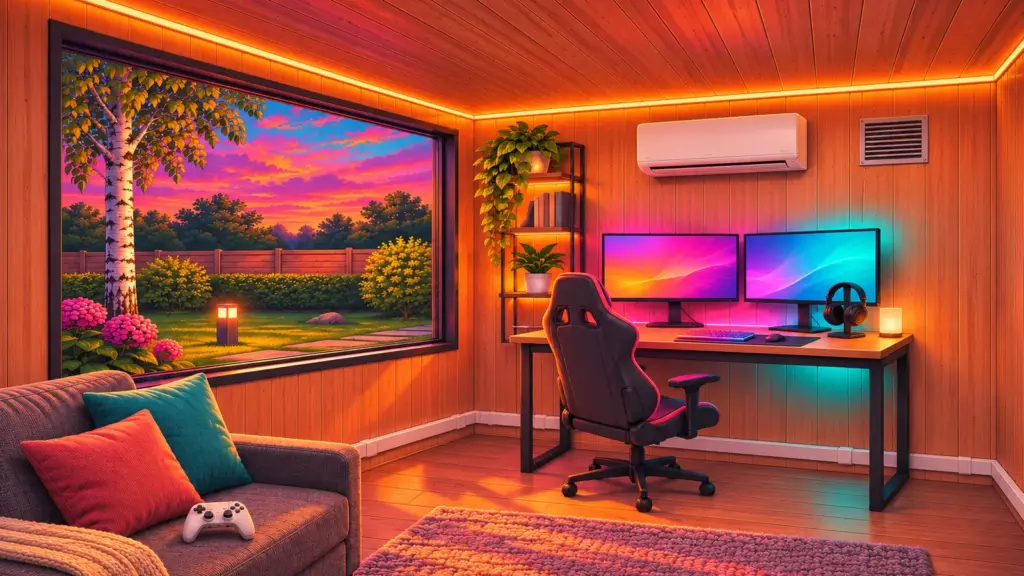
Console, computer, screens and lighting all need power. Power usually comes through a supply line from the house; connection and installation should be left to a qualified electrical contractor. For the network, you can use either a cable from the house or a wireless connection. Plan both in early, otherwise your room will later get stuck on the loading screen.
Your hardware has demands too: electronics are temperature-sensitive. An uninsulated steel container heats up considerably in the sun and sweats in the cold. The devices themselves also warm the room while in use. A shaded location reduces temperature peaks. For the cold season, a heater is part of any container room you spend time in.
The final boss is called condensation. Shipping containers have only minimal ventilation openings as standard; these are not designed for active dehumidification. When warm, humid room air meets cooled steel surfaces, especially on the roof, condensation forms. A container that people stay in therefore needs insulation and ventilation and, depending on the insulation material, a vapour barrier too. The tactics for this boss fight are in our guides to insulating a container and condensation in a container.
A shortcut without retrofitting insulation: an insulated container comes insulated from the factory and dampens temperature swings, but it does not hold a set temperature; in sustained frost only additional heating helps.
Skill tree for conversion: windows, door and interior fit-out
A shipping container can be retrofitted, for example with windows, an additional door, ventilation openings and a cable entry for the power supply. As in any skill tree, the order matters: during fit-out, the openings and the first-fix electrics come first, followed by insulation, vapour barrier and cladding. So decide on windows, door and cable routes before the walls are closed up.
Coin Container primarily sells containers; transport, conversion and rental are additional services. The work that can be part of a conversion is described on our page on conversion.
Spawn point in the garden: delivery, access and ground
Your container needs level, load-bearing ground, for example compacted gravel or block paving on a load-bearing sub-base; concrete slabs are recommended under the four corners. Lawn is unsuitable, however cosy it looks in the evening light.
Even the spawn needs planning. For delivery by crane truck, you need, in addition to the container length, approx. 3 m of lateral swing area and access for a truck 12 to 18 m long. Check the height beforehand: overhead lines, branches, gate and passage heights. A High Cube is almost 3 m high, and considerably more height is needed temporarily with a crane truck. The process is explained in the guide Delivery and offloading. Transport is a separate item and is not included in the container price.
If your loadout stays in the container overnight, think about the door: the standard locking bars keep the doors tightly shut but are not theft protection; a retrofitted container lock adds protection.
Try the demo first: rent a container
Not sure yet whether your garden makes the cut as a level? Besides selling, Coin Container also rents out new and used standard containers itself; rental is an additional service. You can rent a standard container and use it as a gaming room for a limited time, for example to try it out or for a party to celebrate the next release; you bring the tech yourself. What you rent is an uninsulated steel container without fit-out: electricity, lighting, ventilation and, depending on the season, heating are for you to plan, as described above.
And there is a second game mode: to order, Coin Container builds a ready-made gaming room, for purchase or rental. For a permanent, fixed fit-out, buying is generally the right choice; renting suits a container that is only needed for a limited time. Read more about renting on the page where you can rent a container.
Frequently asked questions about gaming containers
How do I get a quote for a container as a private individual?
As a private individual, you request a tailored quote through the enquiry form. There you also state whether you want transport: with offloading, without offloading or self-collection.
Can I also rent a gaming room in a container?
Yes: Coin Container rents out standard containers that you can use as a gaming room for a limited time; you bring your own console, computer and screens. You also need to plan for electricity, lighting, ventilation and, depending on the season, heating, because a standard container is uninsulated and has no fit-out. For a rental, enter the rental start and rental end in the enquiry form.
Is a 10 ft container enough for a gaming room?
That depends on how many seats you are planning: a 10 ft High Cube is approx. 2,84 m long, approx. 2,35 m wide and approx. 2,70 m high on the inside before fit-out. For co-op mode, a 20 ft High Cube offers approx. 5,90 m of interior length.
Save point: request a quote
Ready to press start? In the enquiry form, you choose “Buy a container” or “Rent a container”, plus container type, container size, condition and quantity, and optionally accessories such as container locks or a ramp. You send your enquiry via Request a quote, after which Coin Container will get in touch with you.