Guides & basics
How heavy is a container? When it comes to container weight, there are three values: the tare weight, the payload and the maximum gross weight. If you know the weight of a container, you can plan the cargo, transport and site realistically. This article explains the three terms, gives the guide values for 10, 20 and 40 ft containers from our size table and shows what the weight means for the crane and the ground.
Tare weight, payload, gross weight: what do the three values mean?
The tare weight, also called empty weight or tare, is the weight of the empty container. The payload is the weight of the cargo; the maximum payload states how much cargo the container may take. The maximum gross weight is the total weight that the container and cargo together must not exceed. It is the tare weight plus the maximum payload.
Two questions usually matter for your planning: how heavy is the empty container, and how much cargo may go in? The first is answered by the tare weight, the second by the maximum payload.
You can read some of this information directly on the container. The CSC plate, a sign usually found on the left container door, states the maximum gross weight, among other things. The CSC plate also shows the country of approval, date of manufacture, stacking and racking load values and the date of the next examination.
What does a 20 ft container weigh empty, and how much can it carry?
According to our size table, the empty weight of a 20 ft container is approx. 2.200 kg and its maximum payload approx. 28.000 kg. The maximum payload is an upper limit: container and cargo together must not exceed the maximum gross weight.
A 20 ft High Cube is taller than a standard container; the length and width are the same. According to the table, it weighs approx. 2.350 kg empty, and its maximum payload, as with the standard model, is approx. 28.000 kg. So for the 20 ft container, the extra height makes no difference to the permissible load.
You can read more about this size on the page where you can buy a 20 ft container.
What does a 40 ft container weigh empty, and how much can it carry?
According to the table, the empty weight of a 40 ft container is approx. 3.700 kg and its maximum payload approx. 26.500 kg. The 40 ft High Cube weighs approx. 3.900 kg empty and may carry approx. 28.500 kg.
An empty 40 ft container weighs considerably more than a 20 ft container, but may carry slightly less. So double the length does not mean double the payload. With heavy cargo such as machinery or metal parts, the weight often sets the limit before you run out of space. In that case, the 40 ft standard container mainly gives you more space, but no higher payload.
For detailed information on this size, go to the page where you can buy a 40 ft container.
Container weight at a glance: 10 to 40 ft
The overview shows the tare weight and maximum payload of the five container types for which our size table gives weights:
| Container type | Tare weight | Max. payload |
|---|---|---|
| 10 ft | approx. 1.300 kg | approx. 8.000 kg |
| 20 ft | approx. 2.200 kg | approx. 28.000 kg |
| 20 ft High Cube | approx. 2.350 kg | approx. 28.000 kg |
| 40 ft | approx. 3.700 kg | approx. 26.500 kg |
| 40 ft High Cube | approx. 3.900 kg | approx. 28.500 kg |
Source: table "Container sizes at a glance" on our page about container dimensions and sizes, retrieved on 08.11.2026. That page also lists dimensions and cargo volume. The values are rounded guide values; the values of the individual container are decisive.
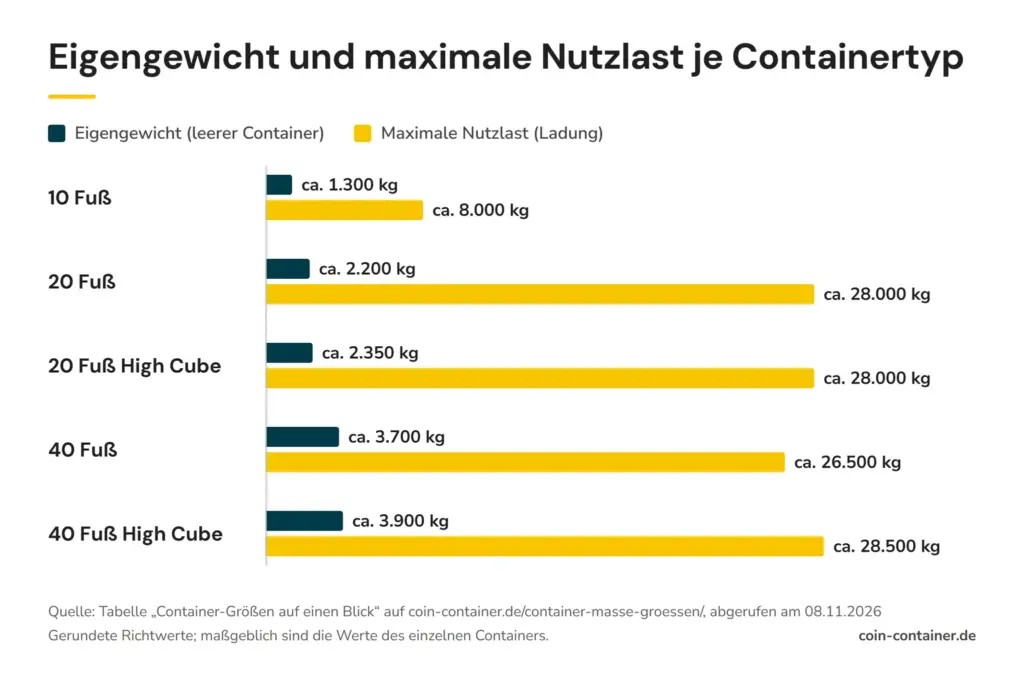
The 10 ft container is considerably lighter than the larger types, but may also carry considerably less. For all types, a gross weight cannot be reliably calculated from rounded guide values. The maximum gross weight is stated on the CSC plate of the individual container.
Shipping container, overseas container, ship container: what does the name tell you about the weight?
Shipping container, overseas container and ship container are common terms for containers used in sea transport. The term alone says nothing about the weight. What matters is the type, for example 20 ft, 40 ft or High Cube, and the specification of the individual container. You can therefore tell the weight of a shipping container, overseas container or ship container from its type: the guide values for 10 to 40 ft are given in the table above.
Not every container that looks like a shipping container from the outside is automatically an ISO container. So only apply the values from the table to the types listed there.
What affects the tare weight?
Apart from the length, the tare weight depends mainly on the design:
- Height: A High Cube weighs slightly more than a standard container of the same length.
- Floor: A steel floor instead of the usual wooden floor increases the tare weight.
- Insulation and conversion: Insulation, interior lining, windows or additional doors increase the weight.
- Equipment: Permanently installed shelving, electrics or ventilation also count.
Whatever extra weight an individual container gains through conversion comes off its payload, provided the maximum gross weight stays the same. This rule applies to the same container before and after conversion, not to a comparison of different types: a High Cube does weigh more, but may carry the same or even slightly more than a standard container of the same length. How much a particular fit-out adds depends on the project. If you want to keep the tare weight low, leave out any fit-out you do not need.
Office containers, refrigerated containers, special containers: weight depends on equipment
Our size table gives no values for office containers, refrigerated containers and special containers. It only contains weights for 10 ft, 20 ft, 20 ft High Cube, 40 ft and 40 ft High Cube.
Office containers are fitted with electrics, heating or air conditioning, insulation, windows and furniture as required. The weight of these containers depends on their equipment and technical systems.
So when you send your enquiry, ask for the values of the specific model as well. Knowing the weight of the chosen model makes it easier to plan delivery and the site, especially if the container is to be moved again later.
What does the weight mean for transport, the crane and the site?
A container can, for example, be delivered by crane truck and offloaded directly on site. How far from the vehicle the crane can set the container down depends, among other things, on the container weight.
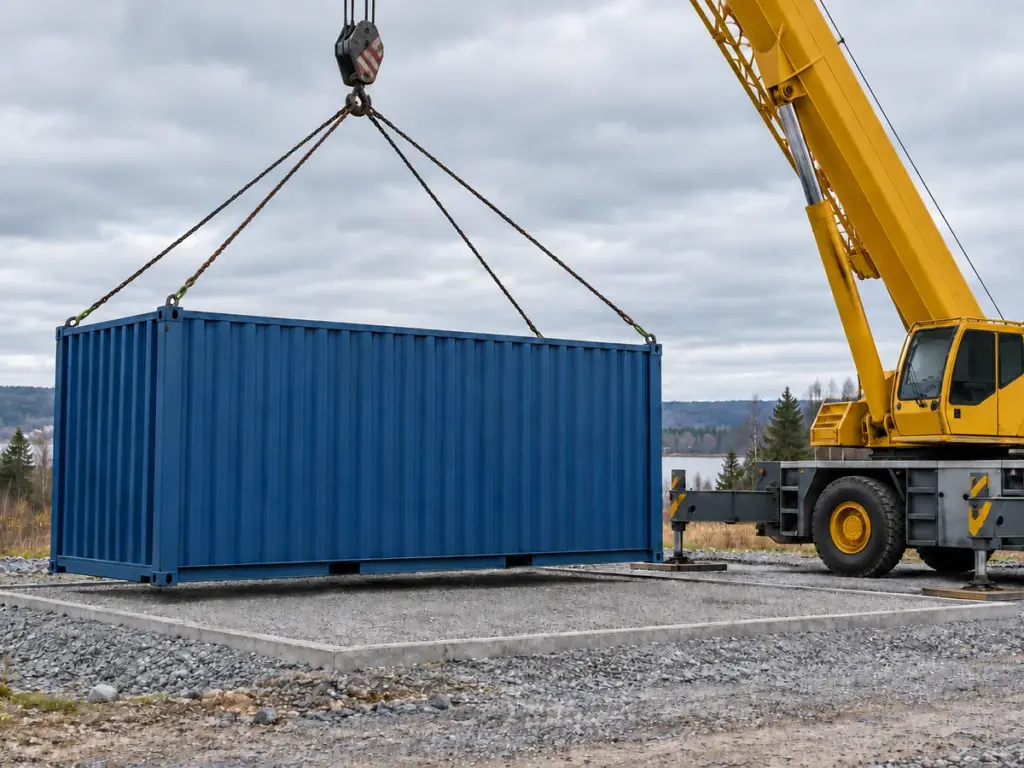
When loaded, a container can weigh many times its tare weight, as the table shows. If a container is to be moved with cargo inside, check in advance whether the vehicle, crane and ground are designed for this.
The vehicle itself also adds weight: together with their load, container trucks reach a high total weight, and extended outriggers create additional point loads. The ground should therefore be level, firm and load-bearing. Before delivery, check the width, height and permissible weight of the access route for the truck.
On site, the load acts as a point load under the four corner castings, that is, at the corners of the container. Suitable surfaces include compacted gravel, asphalt or concrete slabs; on grass or sand, a corner will sink. Concrete slabs under the four corners help to absorb the point load.
At Coin Container, transport is a separate item and is not included in the container price. For more planning tips, see our page on container transport.
If you know the container size, cargo and delivery location, you can go straight to the next step: Request a quote.
Frequently asked questions about container weight
How much does an empty 20 ft container weigh?
According to our size table, an empty 20 ft container weighs approx. 2.200 kg and a 20 ft High Cube approx. 2.350 kg. Both are rounded guide values; the values of the individual container are decisive.
How much does a 40 ft container weigh?
According to the table, an empty 40 ft container weighs approx. 3.700 kg and may carry approx. 26.500 kg. For the 40 ft High Cube, the figures are approx. 3.900 kg tare weight and approx. 28.500 kg maximum payload.
How heavy is a 10 ft container?
According to our size table, a 10 ft container weighs approx. 1.300 kg empty and may carry approx. 8.000 kg. Its maximum payload is therefore considerably lower than that of a 20 ft container.
How much can a container carry?
How much a container may carry is shown by its maximum payload. According to the table, it ranges from approx. 8.000 kg for the 10 ft container to approx. 28.500 kg for the 40 ft High Cube. For each individual container, the rule is: container and cargo together must not exceed the maximum gross weight.
Where is the weight shown on the container?
The maximum gross weight is shown on the CSC plate, which is usually located on the left container door. The plate also states the date of manufacture and the date of the next examination, among other things.
What does an office container weigh?
There is no single value, because the weight depends on the equipment and technical systems, for example electrics, heating or air conditioning, insulation, windows and furniture. Our size table gives no values for office containers. When you send your enquiry, ask about the weight of the specific model as well.